
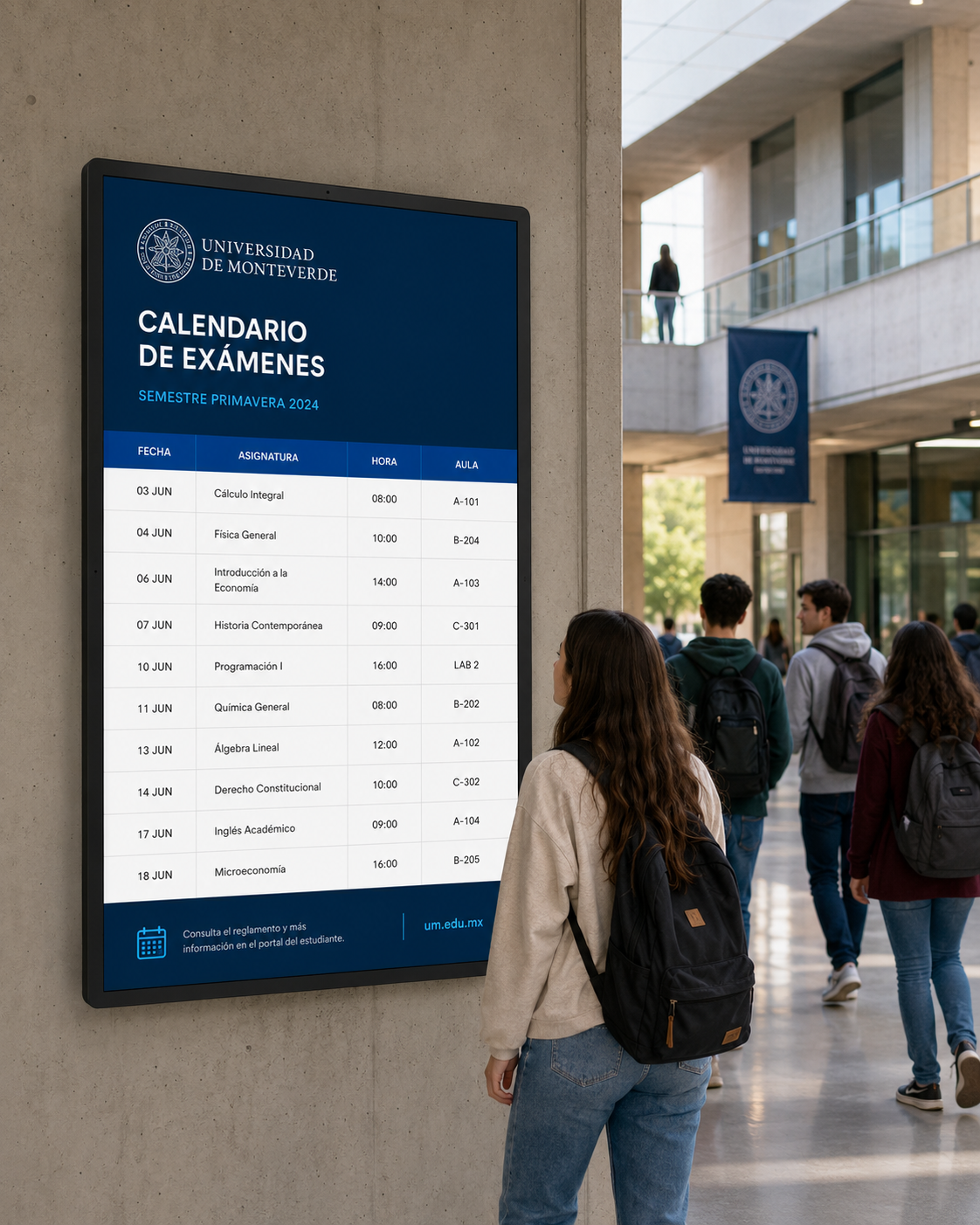
From advertising to internal communications, digital signage is transforming the way organisations engage with their audiences, share information and create more dynamic experiences. For decades, visual communication in businesses, retail environments and educational institutions has relied on relatively static formats: printed posters, noticeboards, traditional signage and announcements that often become outdated before they even reach their intended audience. But what happens when information can be updated in seconds, adapted to its surroundings and delivered to different audiences through a single platform?
The answer lies in digital signage, a technology that is redefining communication spaces and turning professional displays into powerful information channels. And perhaps most importantly, its potential extends far beyond advertising.
What is digital signage and why is it changing the way we communicate?
Digital signage is a visual communication system that uses electronic displays to present multimedia content, including images, videos, information, promotional messages, performance indicators and live updates. Unlike traditional signage, it enables content to be updated, scheduled and distributed centrally, even when displays are installed across multiple buildings, sites or geographical locations.
This represents a fundamental shift in communication: we are moving away from displaying static information towards delivering dynamic, relevant messages tailored to the right time and place. A display is no longer simply a device for showing content. It becomes a communication touchpoint between an organisation and its audience.
The real revolution, therefore, is not about replacing printed posters with screens. It is about transforming how information is managed, delivered and experienced.
Beyond advertising: a new approach to corporate communication
Although digital signage is traditionally associated with shop windows, shopping centres and promotional campaigns, one of its most valuable applications is internal corporate communication. In large organisations, information does not always flow consistently. Emails accumulate, intranet platforms require employees to actively seek out information, and important announcements can easily get lost amongst competing messages. Digital signage offers a complementary approach: bringing information directly into the spaces where people already are.
Consider a company operating across several offices, logistics centres or industrial facilities. Through a network of professional displays, it can:
- Communicate corporate objectives, business results and key performance indicators.
- Share internal news, achievements and employee recognition.
- Promote workplace health and safety campaigns.
- Announce events, training sessions and company activities.
- Provide up-to-date information in reception areas, communal spaces and waiting areas.
- Deliver consistent corporate messaging across multiple locations.
The result is a communication channel that can reinforce organisational culture, increase the visibility of important messages and make relevant information more accessible. Digital signage is not intended to replace traditional communication channels. Instead, it complements them wherever visual communication can offer additional value.
Education: creating more connected campuses and learning environments
Digital signage also offers considerable potential for universities, colleges, schools and other educational institutions. Educational environments are constantly evolving spaces where students, lecturers, administrative staff and visitors all have different information needs. A network of digital displays can transform how these institutions organise, manage and distribute information. Imagine a university where displays at building entrances highlight upcoming academic events, corridor screens communicate classroom changes, and displays in communal areas promote work placements, international programmes and cultural activities.
In libraries, they can communicate extended opening hours and service availability. Within faculties, they can promote conferences, research projects and careers events. Across outdoor campus areas, they can help students and visitors locate buildings, activities and facilities. Furthermore, in situations requiring urgent communication, a properly integrated digital signage infrastructure can provide an additional channel for broadcasting safety instructions and emergency announcements.
The objective is not simply to install more screens, but to make information more accessible, relevant and useful to the entire educational community.
Retail, Hospitality and Public Spaces: delivering the right message at the right moment
In commercial environments, digital signage enables businesses to connect their messaging with the decisions customers make throughout their journey. A retailer can tailor promotions according to the time of day, season or specific marketing campaign. A restaurant can update menus and special offers without replacing printed materials. A hotel can promote its services, activities and events across different areas of the property.
In public spaces, airports, railway stations and healthcare facilities, digital displays can help visitors find their way, communicate operational information and provide important public announcements. This ability to adapt content to its surroundings is one of the fundamental differences between digital signage and traditional communication formats.
The right message, in the right place, at the right time. A simple principle that has become increasingly important in a world where attention is fragmented and organisations must communicate more clearly, efficiently and effectively.
The key benefits of digital signage
The adoption of professional digital signage solutions delivers advantages that extend well beyond visual appeal.
1. Real-Time Content Updates
Messages can be changed instantly without physically replacing printed materials. This makes it easier to communicate time-sensitive information, promotions, announcements and operational updates.
2. Centralised Management Across Multiple Displays
Using compatible content management platforms, organisations can manage displays installed across different buildings, cities or locations, maintaining consistent communication whilst allowing content to be tailored locally.
3. Greater Flexibility and Adaptability
A single display can present different content throughout the day, adapting to specific schedules, audiences and communication objectives.
4. More Engaging Visual Experiences
Video, animation, high-resolution imagery and multimedia content make it possible to present information dynamically and improve its visibility.
The aim is not simply to attract attention, but to make messages easier to understand and remember.
5. Long-Term Operational Efficiency
Digital updates reduce the need to print, distribute and install new materials whenever a campaign or communication changes. Although digital signage requires an initial technology investment and appropriate energy management, it can generate operational efficiencies in environments where content changes frequently.
6. Scalability and Control
From a single display in a reception area to networks spanning multiple stores, offices or university campuses, a digital signage solution can expand in line with an organisation’s needs.
Technology matters, but strategy matters even more
One of the most common mistakes when implementing digital signage is focusing exclusively on choosing the displays. However, its real value comes from combining three essential elements: professional hardware, content management software and a clearly defined communication strategy.
Before deploying a network of screens, organisations need to identify what they want to communicate, who their audience is, where the information should appear and how frequently it needs to be updated. It is equally important to consider installation conditions, including ambient lighting, viewing distance, screen orientation, operating hours, connectivity and remote management requirements.
A display installed in a meeting room does not have the same requirements as one positioned in a brightly lit shop window, a university corridor or an outdoor information point. Similarly, having the right tools to schedule content, manage devices and maintain a consistent visual experience is essential if the installation is to continue delivering value over time. The most effective digital signage solution is not necessarily the one with the most screens, but the one that communicates most effectively.
What does the future hold for digital dignage?
The future of digital signage lies in increasingly connected, automated and adaptable systems. Integration with business platforms, content management tools and data sources is creating new opportunities to deliver communications linked to operational information, schedules, room availability and real-time performance indicators. There is also growing potential to tailor content according to factors such as time of day, audience requirements and environmental conditions. Artificial intelligence can help simplify certain aspects of content creation, categorisation and adaptation, provided that organisations maintain a clear communication strategy and manage data responsibly.
In this evolving landscape, professional displays are moving beyond their traditional role as audiovisual devices to become integrated components of an organisation’s digital infrastructure. And this is perhaps the most significant transformation of all: visual communication is evolving from a static medium into a dynamic, manageable and connected service.
Newline Interactive: the right digital signage solution for every environment
At Newline, we understand that every environment presents different communication challenges. That is why our professional digital signage portfolio offers solutions designed to meet a wide range of display, installation and operational requirements.
- Newline STV+: Professional 4K displays designed for corporate, educational and commercial environments, featuring 24/7 operation and remote management capabilities. A versatile solution for bringing visual communication into indoor spaces.
- Newline DSX: A range specifically designed for professional digital signage applications, offering high brightness of up to 700 nits, portrait and landscape installation options, and features developed for demanding commercial and professional environments.
- Newline XRT: Newline’s outdoor digital signage range, combining high brightness of up to 2,500 nits with robust construction designed to withstand challenging environmental conditions. An ideal solution for extending visual communication beyond indoor spaces.
These product ranges can be integrated with compatible Newline software solutions, including Newline Signage Pro and Newline Display Management Plus, helping organisations distribute content and manage their devices more efficiently.
Ready to Transform the Way Your Organisation Communicates?
Whether you are looking to improve internal communications, modernise signage across an educational institution, create more engaging retail experiences or develop an outdoor digital signage project, Newline Interactive can help.
Get in touch with our sales team and discover the digital signage solution that best suits your project.